

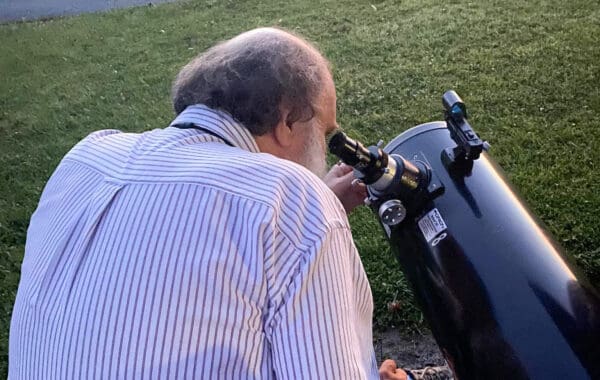
Join local astronomers (every second Saturday of every month) at Grand Vue Park for a family-friendly telescopic StarWatch. This Saturday, March 8th, 2025, the StarWatch will be held at the unique vantage point of Grand Vue Park’s Zip-line Adventure Area, high above the surrounding region at 39° 56’ 42” N and 80° 43’ 49” W from 8:00 to 10:00 PM. If the sky is clear, the Sun will have already set by 6:23 P.M., leaving a Moon-lite-dark view on all horizons by 8:00 P.M..
Using telescopes on-site, amateur astronomers will telescopically reveal to those in attendance the planet Venus, Earth’s Moon, the planet Mars, and the Planet Jupiter and his four planetary-sized moons, numerous deep space objects within and beyond our Milky Way Galaxy will add “Wow” to the evening.
The first order of StarWatching business is to catch the planet Venus setting on the western horizon. Venus goes through phases like Earth’s Moon. See Venus as an amazingly thin 7.6% crescent. As Venus sets through the thickest part of Earth’s atmosphere – along the horizon – look for shimmerings and refractions of scintillating rainbow hues.
After Venus sets, we will view Earth’s planetary-sized Moon (Luna) only 1.3 light seconds away. Luna will be majestically illuminating the high southern sky. Telescopically, the cratered and mountainous details of Luna appear truly stunning. Telescopes will be made available for viewing Earth’s Moon as a waxing gibbous – almost full. Nearly 75% of the Lun-ar nearside will be illuminated. Get your SMART Phones ready to take your very own eye-catching lunar image souvenir / Screen Savers through the telescope.
As an added treat, diminutive Mars (not “The Red-Planet” as you will clearly see) will be seen telescopically as a small bright rusty globe just below and to the right of Luna. Look for surface markings and bright polar caps of the amber-colored planet, if the air is steady.
After observing Mars and Earth’s Moon – Luna, we will turn our attention below and to the right of Luna to find the brilliant planet Jupiter. It should be noted that Venus, Jupiter, Mars, Luna, and the location of where the Sun set – make a “line” in the sky – the “Ecliptic” – where the planets, Luna, and Sun are found. We will easily see Jupiter’s cloud bands, the Great Red Spot, and the four Galilean planetary-sized Moons, each will be described in detail at the StarWatch.
If the sky remains clear, we will search for several of our favorite bright Winter/Spring-time Deep Space Objects, bright stars, double stars, star clusters, nebulas, and Constellations.
Reminder, we will have telescopes for you to use … if you have a telescope, bring it along – more scopes, means more fun.
In case of clouds or light rain, amateur Astronomers will still be there to engage your astronomical questions and banter about the wonders of the Cosmos. In case of steady rain, snow, or ice – the Grand Vue Park StarWatch event will be cancelled.