

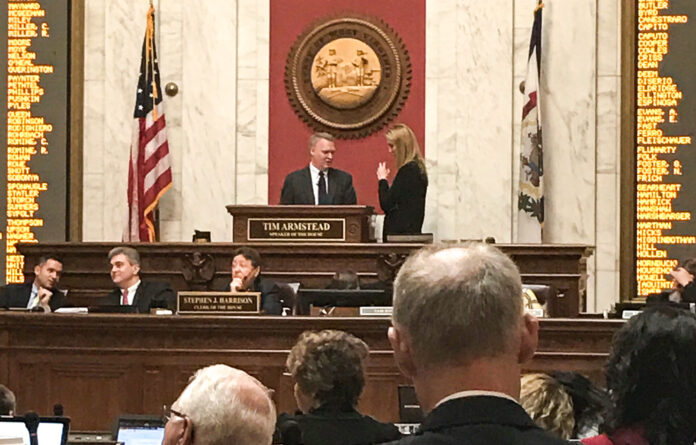

In the months leading up to my first election to the West Virginia House of Delegates in 2010, I spent many hours on the phone with Tim Armstead and Larry Border.
Both of them gave freely of their time, sharing wisdom, encouragement, and practical advice about campaigning and what it meant to serve. For a time, they were names, and their voices carried me through that uncertain season. It was not until I met them in person that everything really came to life. I remember realizing in those moments that these were not just political colleagues. They were men of faith, conviction, and integrity. Larry left us far too soon, just after my first session in June 2011.
Now losing Tim feels like losing another anchor, another steady hand who shaped not only my path in public service but also my understanding of what leadership should look like.

At that time, Tim was serving as Minority Leader. He carried himself with quiet confidence and a kind of moral compass that was hard to miss. While others might have been tempted to lead with volume or partisanship, Tim led with principle. He believed in the institution, in the people of West Virginia, and in the calling of public service. For me, as a brand-new legislator, his example was invaluable. He became not only a mentor but also a friend.
I sat directly behind Tim and Larry on the House floor. I hit the jackpot of seats. I learned a great deal from both of them.
I think back to those early days and how he always made time, time to explain, time to encourage, time to listen. In politics, where too many egos can overshadow empathy, Tim was different. He was patient, and he treated my questions with the same seriousness he gave to more seasoned members. That was one of his gifts. He never looked down on anyone but instead found ways to lift people.
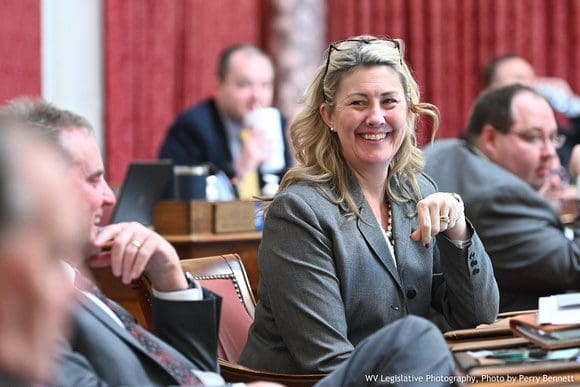
He helped me and permitted his sweet daughter, Katie, to babysit my children when they visited Charleston. In that simple way, our families became a little more closely connected. The first question each of my children asked when hearing the news was, ‘How is Katie?’ They knew just how much her dad meant to her.
It is one thing to respect someone professionally, but it is another entirely to welcome them into your personal life, to trust them with what matters most. That bond reflected the kind of person Tim was. He built relationships that lasted because they were built on trust and sincerity.
In 2015, when he became Speaker of the House, he carried those same qualities into the role. Leadership did not change him. It simply gave him a larger platform to demonstrate what servant leadership looks like. He understood that the position was not about personal power but about stewardship. He believed that leadership meant listening, guiding, and creating space for others to succeed. Even those who disagreed with him politically could not deny his fairness and integrity.

In 2018, when Tim was appointed to the West Virginia Supreme Court of Appeals, it felt like a natural continuation of his life’s work. Justice fit perfectly. The qualities that made him a trusted legislator, his even temper, his grounding in principle, and his dedication to justice and fairness, made him equally suited for the judiciary. Once again, he approached the role not as a position of privilege, but as a calling to serve.
He was a servant leader in the truest sense. He did not chase titles or recognition. He carried them when entrusted with them, but he never let them define him. What defined him was his faith, his devotion to his family, and his genuine love for West Virginia.
That devotion was most visible in the way he loved his wife, Anna. His respect and admiration were evident in every conversation, every introduction, every moment he spoke of her. The strength of their partnership was something to admire. It was rooted in mutual faith, encouragement, and an unwavering bond. They were a team in every sense of the word, and his love for Anna was easily seen as an anchor throughout his public service.
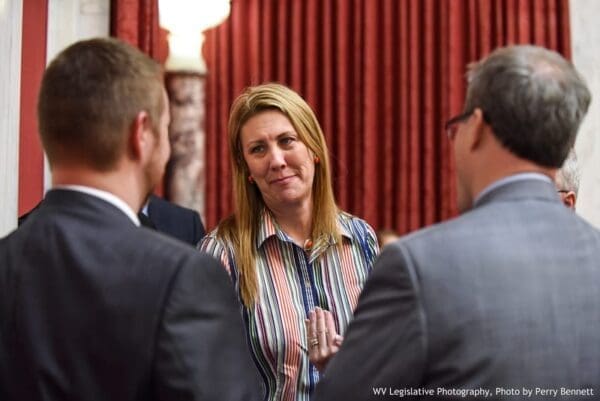
Losing him is felt by many who have had the honor of serving with him, but it is also a loss for our state. Many, like me, have shared how they will miss his encouragement, his wisdom, and his friendship. Our state will miss the way he worked to bring people together, to temper disagreements with decency, and to remind us that public service is about people, not politics.
There is a comfort in knowing his legacy will not end with his passing. His influence lives on in the many people he mentored, the colleagues he inspired, the laws and rulings he helped shape, and, most of all, in his family. His daughter Katie, who once watched over my children, carries the same spirit of kindness and faith that her father exemplified. His grandchildren, Ben and Ann, will grow up with stories of their grandfather’s integrity, his faith, and his service. They are his legacy too, and through them, his light will shine for years to come.
When I reflect on what Tim meant to me, the word that comes most clearly is gratitude. Gratitude for the time I had to learn from him. Gratitude for the example he set in a world that too often forgets the value of humility. Gratitude for the laughter and friendship we shared beyond politics. Gratitude that my children’s lives were touched by his family’s love.
Tim Armstead showed me, and so many others, that servant leadership is not about seeking power, but about using whatever position you hold to serve others with faithfulness and integrity. That is a lesson I will carry with me for the rest of my life. Though we grieve his loss deeply, I know his life’s example will continue to guide me, wherever I go, whatever I do, as I strive to serve in my own way.
West Virginia has lost a great leader, and I have lost a mentor and friend. I think of Larry Border, who we also lost far too young, and how both he and Tim shaped the start of my journey. Their legacies remind us that the measure of leadership is not in the offices we hold, but in the lives we touch. Tim touched mine, as Larry did, and I will always be grateful.