

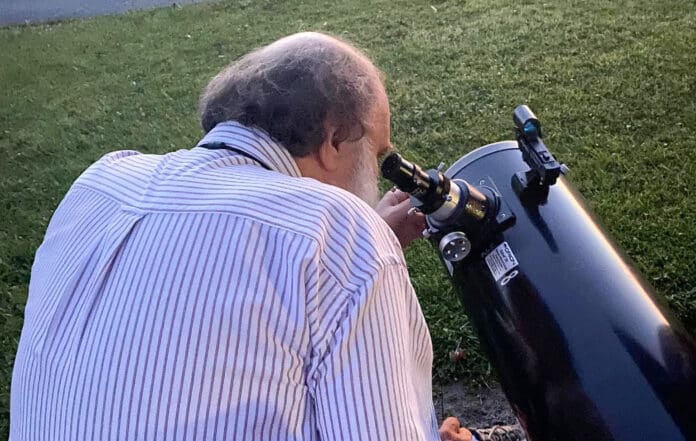

Hey Astronomy Fans, bring your Valentine to the StarWatch!!!
Join us (every second Saturday of every month) at Grand Vue Park for a family-friendly telescopic StarWatch. This Saturday, February 14th, 2026, the StarWatch will be held at the unique vantage point of Grand Vue Park’s Zip-line Adventure Area, high above the surrounding region at 39° 56’ 42” N and 80° 43’ 49” W from 8:00 PM to 10:00 PM. The Sun will have set by 5:58 PM local time.
Using telescopes on-site, amateur astronomers will telescopically reveal to those in attendance the planet Jupiter and his four planetary-sized Moons – Io, Europa, Ganymede, and Callisto, the planet Uranus and planet Saturn with her ring system and her planetary-sized moon Titan and possibly nearby distant Neptune, as well as stars clusters, nebula, and a multitude of the Deep Space Objects within and beyond our Milky Way Galaxy.
By the start of the StarWatch at 8:00 PM, if the sky is clear, Grand Vue Park will be dark enough to see a swarm of bright and dim stars above us in our Moonless sky. We will show those in attendance how to pick the planets from the stars. Planets as a rule do not twinkle – stars as a rule do twinkle.
The first order of the StarWatch night will be looking into the low western sky. We will look for the planet Saturn just less then 1.5 light hours away from the Earth at the speed of light. Saturn is found setting on the western horizon as a pale-yellow non-twinkling object. Look closely in the telescope at Saturn’s ring system. As seen from the Earth her ring system appears almost edge-on. The largest and brightest of Saturn’s 274 known moons is the planetary-sized moon – Titan.
As we watch Saturn settle below the horizon, we will turn our attention and telescopic viewing high into the southeastern sky. The bright white non-twinkling object is the brightest celestial object for this StarWatch. Our telescope reveals the Jupiter System consisting of the largest planet in the Sol-ar System – Jupiter with visible cloud banding and his four large, planetary-scale moons only 37 light minutes distant.
Once we have seen the Saturn System sky-treasures and the amazing Jupiter System, we will look nearby for the distant planet Neptune (just over 4 and a quarter light-hours from Earth) and the planet Uranus at only 2.6 light hours distant.
If the sky remains clear, we will search for several of our favorite bright winter-time Deep Space Objects: Double Stars, Star Clusters, Nebulas, Galaxies, and Constellations.
Reminder, we will have telescopes for you to use … if you have a telescope, bring it along – more scopes, means more fun.
In case of clouds or misting rain, amateur Astronomers will still be there to engage your astronomical questions and banter about the wonders of the Cosmos. In case of steady rain, thunderstorms, or snow and or ice – the Grand Vue Park StarWatch event will be cancelled.