

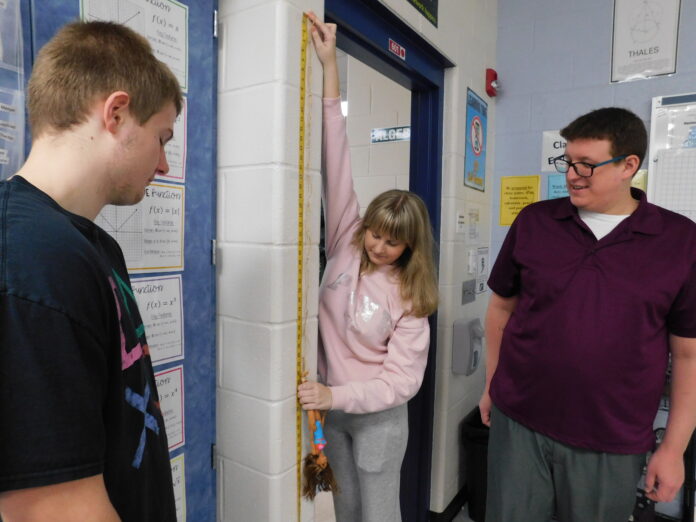

BRIDGEPORT – Bridgeport High School math teacher Mackenzie Krieger is showing his students how to put math to use in daily life with his Advanced Quantitative Reasoning course.
“It’s an equivalent course for Algebra II, so students who are not going on to a STEM-related field, who don’t need the higher calculus courses, can take this course in place of Algebra II, and it’s kind of a more practical, real-life math course,” he said.
AQR has been active in Bridgeport High School for five school years, and Krieger is proud of his early role in shaping the curriculum for Ohio. The course was originally named Math Modeling and Reasoning, and Krieger was one of about 100 teachers statewide who piloted the class. For the first three years the class was offered to smaller groups of students while Krieger and other teachers communicated, discussed projects and continually made improvements.
“Now every school in Ohio has the ability to offer this course just as of two years ago,” he said.
“I would say over half of the state is offering this course. We were the first ones in Belmont County, and now maybe half the county is teaching it,” he said. “I also have had different teachers come in and observe the class from different schools in the area that have thought about adding the course.”
AQR ties math into modeling and reasoning. Krieger’s students apply those models in their experiments and in tasks they might undertake.
The students were active in mid-January as they worked on their latest project, a “Barbie Bungie Jump” where they enacted bungie jumping using Barbie dolls and rubber bands and created models predicting how far the doll will fall based on the number of rubber bands. The students worked out models with Krieger pointing out different experiments to test their conclusions.
“They have to reason their way through their answers. It’s not just coming up with an answer to a variable, it’s giving the reasoning behind how they got to that answer,” he said.
They will put their modeling skills to the test later in January, when Krieger will give them a height and the students will calculate the number of rubber bands needed for a successful “bungie jump.”
This is only one of many projects, often incorporating the use of school iPads.
Krieger said another popular assignment is Driving for Gas.
“They have to determine whether it’s worth driving farther away for gas that is cheaper, or if they should just buy gas that’s closer. It’s that reasoning that is the important part.”
Other assignments have applications to managing money.
“We do some things with finance units. We talked about how credit cards and how credit card interest works,” he said.
Other projects call for students to analyze police reports and look at skid marks on the ground to gather evidence of who was at fault in an accident. They learn how police can determine the speed of a vehicle when no one was present to observe.
“Everything we do here is really hands-on, practical, everyday life stuff.”
Krieger said one goal is a change in mindset in how his students look at and engage with problems.
“It’s less solving equations and more explaining your reasoning,” he said. Students are encouraged to use trial and error.
“Teaching this course is much different than teaching a traditional course. It’s very much a student-led course where the students make their discoveries on their own.”
He has three classes this school year. A total of about 20 to 25 students take the class each year.
Krieger has also developed an AQR 2 course, now in its second school year.
“Which focuses more on statistics and data collection, so they take that as a senior,” he said. “More on collecting data, doing research. It’s kind of a hands-on way of teaching probability statistics.”
Krieger said his AQR 2 students have been able to build on what they have learned. They are now working on a data analysis project, which involves creating a survey for their fellow students to fill out. They will then collect and analyze the data to draw conclusions. The students will write their own research papers.
“There just so much material that we can do in here, that I felt like a second year would really be beneficial,” he said.“It’s going really well. I’ve had students produce some really cool projects in there.”
Senior Addison Wagner loves the class.
“I like seeing stuff visually. I think I learn more hands-on.”
Junior Evan Clark found the Driving for Gas problem interesting. He also learned how to use technology such as the Gas Buddy app for his research.
“It showed me if it was better to go farther for cheaper gas.”