

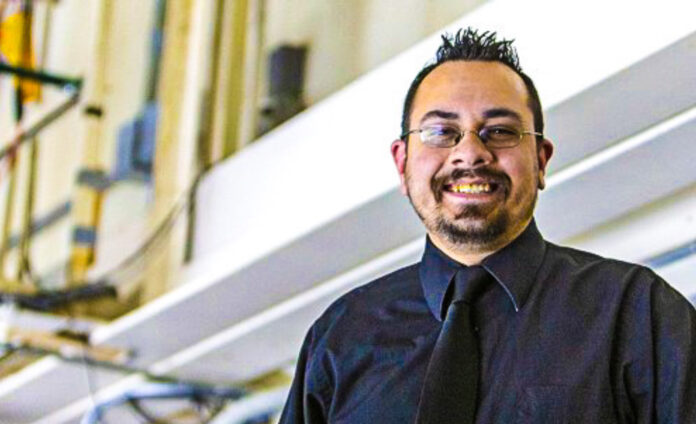

DJ Abisalih is one interesting dude.
Get this: Not only is he a native of Maine who had never tasted lobster until he went to Red Lobster in St. Clairsville a few years ago, but he didn’t like it either.
Seriously, though, the guy is a New Englander to his core when it comes to his beloved Bruins, Red Sox, and Patriots, but he’s a fan of all sports, too, and he’d watch a cricket match instead of a political debate anytime. Hockey, of course, is the man’s main squeeze, but his first gig in pro sports was in minor-league baseball – and, yes, he’s voiced plenty of opinions each week about how the Pirates could compete again during the “Flooring Center Sports Hour
And let’s not forget he’s also the announcer for the volleyball team at Martins Ferry High School.
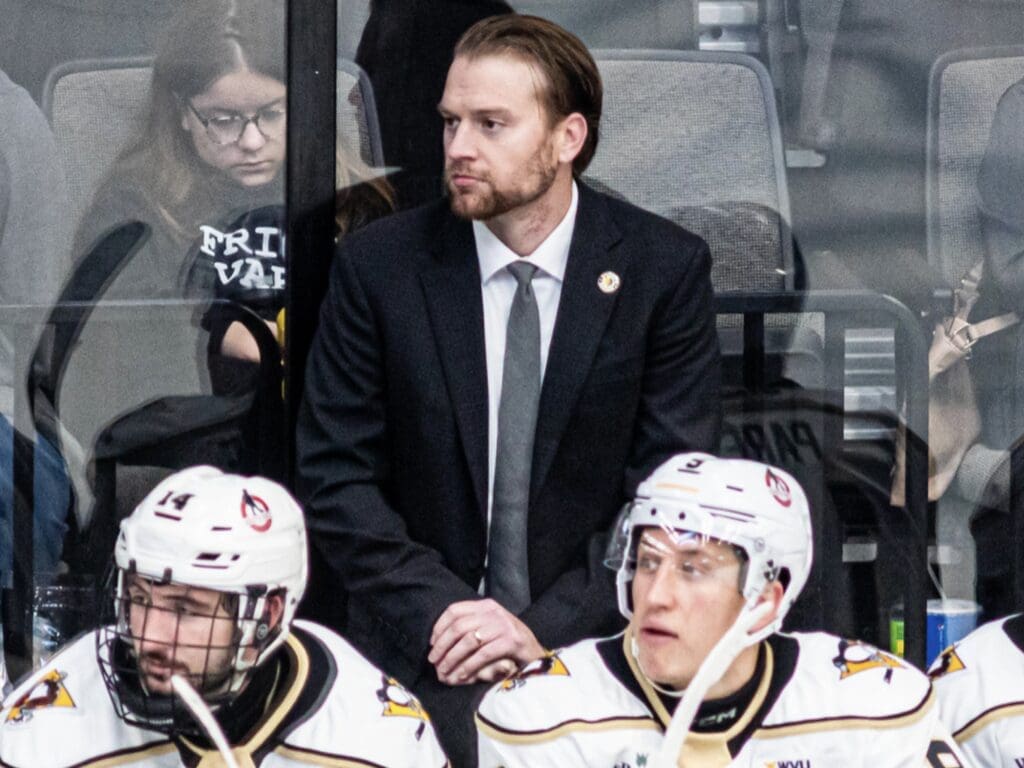
This Nailers season, though, will be a bit different for Abisalih, especially since his dear friend is no longer a player or the Nailers’ head coach and his color commentator is now on his way to Georgia.
Derek Army, who first joined the Nailers in 2014 as a promising prospect and helped guide Wheeling to the league’s Kelly Cup Finals in 2015-16, signed this offseason with the AHL’s Colorado Eagles as he continues his quest for the NHL ranks.
It was announced earlier today that Isaac Basinger, Abisalih’s on-air partner for the past five seasons, has accepted a position with the Savannah Ghost Pirates and former Wheeling Thunderbird Brock Woods will assume color role for the Nailers.
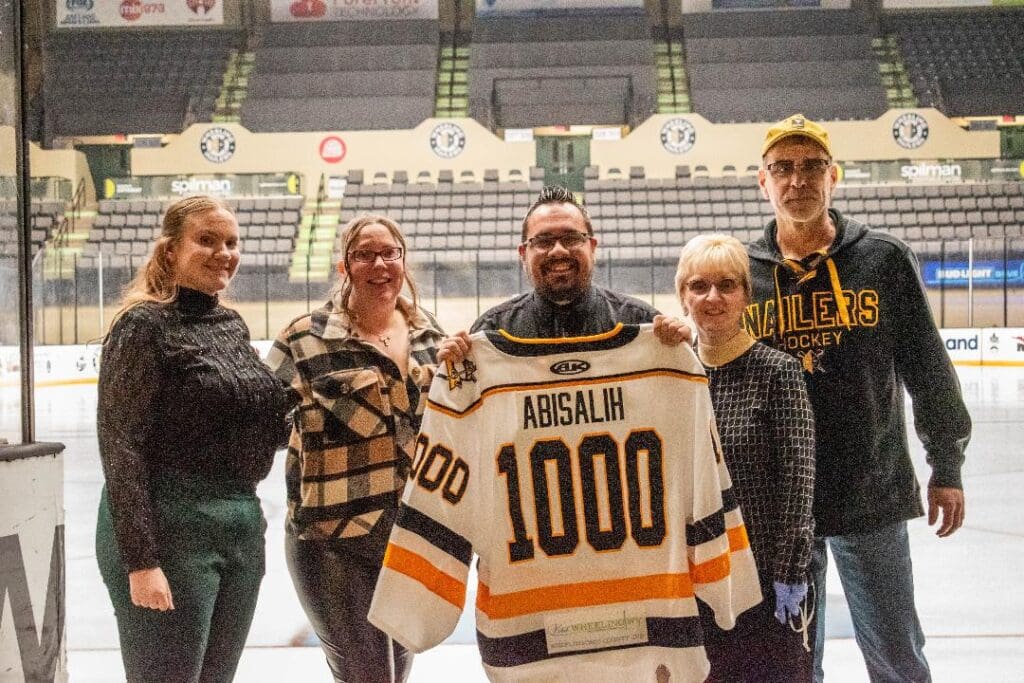
So, while he will miss his friends, he’s no stranger to change with the Wheeling organization, the oldest franchise in the ECHL that has sent the most players to the NHL than any other team in the league. Abisalih, who also serves as the team’s director of media & community relations, has called more than 1,000 games for the Nailers, he’s welcomed Army’s replacement, Ryan Papaioannou (his ninth different head coach) to the Friendly City, and he’s now preparing for his 15th season as the key cog and the common denominator when it comes to the success the Wheeling Nailers since his arrival in 2011.
How did former head coach and player Derek Army permanently change the Wheeling Nailers?
For me, the area that Derek Army changed the most was how he was more than just the coach of the hockey team. He made Wheeling his home for his family, and he connected his personal family with his hockey family.
Community has always been a major pillar for the organization, dating all the way back to when Doug Sauter’s squad first arrived on the scene in 1992. There has always been an understanding that the team needs to play a big role in the community, and in turn, the community plays a big role for the team.
For the team to have that type of presence in the community, there needs to be buy-in from the head coach. That message gets communicated before pen gets put to paper when a new coach is in the process of being hired. While most coaches have understood that, Derek took it to another level.
Most of the head coaches that I have worked with during my time here had significant others and children, but a good number of them didn’t move here with the coach, much less be front and center. Not only were Jenny, Boone, and Adelina here with Derek, but they took part in events and the fans got to know who they were.
One of the neatest events I watched with the Army family was the Ogden Wellness Weekend in 2024. Some years, the season would end, and the coaches were out of town so quickly that all you could see was a vapor trail. That wasn’t the case with Derek and family, and on this day, Jenny ran the half-marathon, Boone and Adelina ran the tiny tot trot, and Derek was everyone’s biggest supporter. Nobody asked them to participate – they did it, because they wanted to get out and do something fun as a family in the community.
That “Community First” attitude is infectious, and we saw that from Mitch Giguere’s family as well. Maxim, Alexe, Leoni, and Louie are older than Boone and Adelina, so there were more opportunities to assist on game nights. Mitch’s wife Audrey got the kids together and created a face painting station, which fans can visit at every home game. They didn’t just show up, watch the game, and go home. They wanted to be part of the fun with Mitch. And you could always count on both families to be skating around on the ice following Sunday home games.
Winning and development are both great traits to have on the ice, but Wheeling wanted a person they can get to know off of the ice, and someone who embraces this city as their own.
How has the organization changed since you were an ECHL rookie broadcaster in 2011?
From 1998-2003, the ECHL was known as the East Coast Hockey League. In 2003, it got rid of the wording and now just goes by the four letters. However, those of us in the league will joke around, and tell you that ECHL stands for the Ever Changing Hockey League. All joking aside, change is something you expect when you work in sports. However, what makes it cool is when you can take a step back and not only look at how things have changed, but how they have evolved.
The most obvious change from 2011 to 2025 internally is the staff. When I first started, not counting Rob & Jim Brooks, there were six of us in the front office – three salespeople, one person running business operations, one secretary, and me. I was seasonal during my first year, too, so I went back to Maine from May through September.
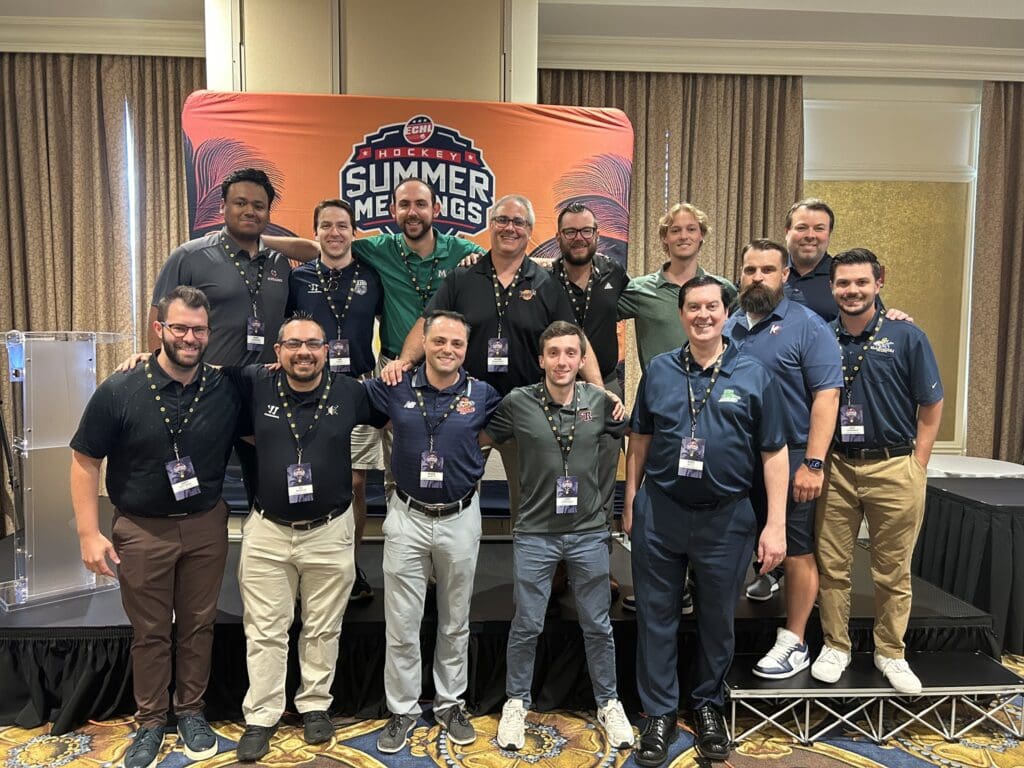
Now, not counting RED, there are 11 of us, and we are all year-round employees. Not only have we grown in numbers, but we have grown in the different jobs that are done. We didn’t have a merchandise manager in 2011, marketing used to be a combined effort of our business operations director and me, and game operations was handled by one of the salespeople. More roles and more specific roles for individuals have given us a greater chance to succeed as an organization.
Fans will likely tell you that the most notable change since 2011 is the design of the arena and the fan experience, and both of those are true as well. From the jumbotron to the seats, and the main lobby with the team store, it is fantastic to see a building that is almost 50 years old thrive with modern amenities. For me, the addition of the jumbotron in 2015 was the most significant upgrade that was made, as it helps us engage and entertain more people, especially on theme nights.
Speaking of theme nights, those and group events are the two areas where I am the proudest of how our staff has grown. There were times when I worked here where the promotional schedule was composed by one or two people, and with that, it was easy for others to feel disconnected. Now, everyone is involved, so we cannot only come up with the best ideas, but every department has a hand in executing them.
While there are plenty of fans who will focus on the on-ice product, sports are in the entertainment business. The 11 of us on the business side can’t control wins and losses, but we can control that you leave with a fun and memorable experience. The most satisfying thing for me is when I am working at our table at an event during the summer, and a fan is eager to share their experience of coming to a game. If something over-the-top noteworthy happened at the game, they will mention that. However, often, they either reference the game they went to by the promotion (Wizards & Wands, Kids New Year’s Eve, etc.), or they reference the group that they went to the game with (Scout Night, Trades Night, etc.). That’s when I know that we’ve done our jobs well.
What is the best advice you’ve ever been offered?
I’m going to start this at the very beginning of my play-by-play broadcasting career when I was hired by the late Bill Schurman to be the voice of the Lewiston MAINEiacs. Bill was all about the people, whether that was showcasing personalities or making an impact.
I began working the 2010-11 season under my friend Alex Reed. Alex got hired by Wheeling 12 games into our season in Lewiston, so I took over as the head guy for the MAINEiacs in game 13. While that was a home game, I had a two-game weekend road trip ahead, which started a stretch of six of seven on the road.
As we were leaving the home game, Bill pulled me aside and told me that I was the fans’ eyes on the road, not only for what’s happening on the ice, but what’s happening all around me. He told me to let the fans live through me. Talk about the arena, the food, what people are doing in their down time, if you see someone significant, etc. People want to hear about the human element more than they want to hear about how many shots on goal the team had on a given power play.
That is advice I’ve carried with me to this day, and it gets me especially excited when we go to a new city, because I have a new arena to describe and new restaurants to try. It also helps to make personal connections with the audience. Player parents love coming up to the broadcast booth and introducing themselves, knowing I will mention it, so that the player’s grandparents will hear it back at home. The same goes for the fans. I love interacting with fans via social media during the games, because it makes them feel like they’re part of the game.
Another piece of advice I liked is one that I got from my friend Everett Fitzhugh. Everett previously worked in the ECHL with Cincinnati and is now the radio broadcaster for the Seattle Kraken. When Everett first got the job in the NHL, the rest of us in the ECHL were all in awe, wondering what the secret method was to get to the NHL. One of the things he told us was to just be ourselves. People already know us and like us as broadcasters because of who we are and what we do, not because of who we think people want us to be. In other words, don’t compromise your personality, just because you think someone might like a different version of you better.
The final piece of advice I’ll mention is one I received from Columbus Blue Jackets Radio Broadcaster Bob McElligott. First, a fun connection led me to Bob. He used to work in baseball with the Syracuse Chiefs, where he had an intern named Mike Antonellis. I worked under Mike for seven years with the Portland Sea Dogs. Who you know makes a difference in this industry. Bob’s advice was simple – do this job until you stop having fun. The second you stop having fun, get out of it. As I’m sure you’ve figured, I’m still having fun.
In your opinion, which sport has the most difficult path to “The Show”? … Why?
When looking at the big four sports in North America, I believe basketball has the most difficult path to “The Show,” and for me it comes down to two main reasons – accessibility and numbers.
Basketball is available everywhere, and it’s a sport that takes minimal equipment to play. There are gymnasiums and outdoor courts with hoops in every town, so all someone needs to play is a basketball and a pair of sneakers. So, from the very beginning, it’s a sport that is accessible to everyone at an affordable price. Football can be an inexpensive sport to pick up in the very beginning, but if a child wants to play competitively, the dollar signs come into the equation with the gear. Baseball is relatively affordable, as only a bat and a glove are required. Organized hockey is crazy expensive, especially when skates are added into the picture.
Basketball can also be easily played regardless of climate, so again, more opportunities. Baseball is extremely challenging in the winter for the northern states, football has a longer outdoor shelf life than baseball, and ice rinks are few and far between in some regions of the country. However, if you go to just about any elementary school or recreation center, you’re more than likely going to see a gym. And if that’s the case, look up, because there will be basketball hoops.
Next, let’s fast-forward to scholastic sports. Not only does just about every high school in this country have a basketball team, but most of the schools have junior varsity and freshman teams. So, it’s realistic to think that there are at least 20-40 students playing basketball in every school.
That number shrinks some in college, but a quick AI search tells me that between the three divisions, there are over 1,000 NCAA men’s basketball teams. If there are 15 players on a team, that’s 15,000 college basketball players.
Now, let’s look at the numbers at the professional level. Among the big four sports, the NBA has the smallest roster size with 15 players. The NHL carries 23 at a time, MLB uses 26, and the NFL leads the charge with 53. So, that’s 450 NBA roster spots, 736 in the NHL, 780 for MLB, and a whopping 1,696 in the NFL.
Taking that one step further, the NBA has one minor league – the G League. Granted, the NFL doesn’t have a minor league at all, but they still have significantly more players at the highest level. The NHL has two affiliated minor leagues and MLB has five levels in the minors. So, in hockey and baseball, there are more opportunities to play within an organization and potentially catch someone’s eye, even if a player is a late bloomer.
One other element that makes the NBA quite literally a lofty goal is that it is a sport where height is a factor. Jose Altuve is nearing 2,000 MLB games at 5’6”, Nathan Gerbe played in over 400 NHL games at 5’4”, and the NFL has had plenty of players under 6’0”. However, in the history of the NBA, there have only been 27 players that have been 5’9” or shorter. Taller players have begun having great success from three-point land, too, which is likely going to make the path to the NBA even more challenging for the shorter players.
Who is your all-time favorite professional athlete and why?
This is such a difficult question, especially now that I’ve lived through multiple eras of sports. Because of where I’m from and who I root for, I tend to lean toward the players who have played on New England teams first. I have always been someone who will cheer for a team over an individual, and yes, I would even boo a family member if they put on the pinstripes of the Evil Empire.
The three main qualities that draw me in to rooting extra hard for a player are talent (duh), hard work, and personality/emotion. If a Red Sox pitcher strikes out a Yankee to end a key inning and keep the lead, I want to see some fire. Yell, pump your fist, let’s go! I also want to see someone who isn’t afraid to have fun, joke around, and show us who they are as human beings.
Since I mentioned the Red Sox, I’ll start there. When you look at the historic 2004 team, everyone will talk about David Ortiz, Curt Schilling, and the elite players from that group, and don’t get me wrong, they’re high on my list, too. But I loved Kevin Millar. He kept the group loose, having fun, and saying whatever he felt like on a given day. Fast forward a few seasons, and you’ll come to Dustin Pedroia. Like me, Pedroia isn’t the biggest guy in the world, but the dude brought it every day, and if you questioned him, he was ready to say, “Oh yeah? Watch this.”
In hockey, the two that I’ve enjoyed the most have been Joe Thornton and Brad Marchand. Thornton was one of the rare players who was able to mix remarkable skill with a hilarious personality. He was always smiling in interviews, ready to crack jokes, and was able to have a Hall of Fame career on the ice. Marchand is another one whose outstanding play will lead him to the Hall of Fame, but I love the rat quality. The fact that he can score 20-30 goals a year, chirp everyone in sight, and annoy half of the hockey world is impressive.
Now that the readers have their skin crawling, I should probably mention the GOAT – Tom Brady. If you talked to any New Englander in 2000, they would have told you they would have been ecstatic seeing the Patriots win one Super Bowl. Well, here we are with six, which is an insane accomplishment in sports today. The accolades speak for themselves on TB12, but selfishly, now living here and seeing him go 12-3 as a Patriot against the always passionate Steelers, including 3-0 in AFC Championship Games, puts a big smile on my face.
One final athlete who I really appreciated watching was one who shined as an individual – Tiger Woods. Without Tiger, I don’t know if I would have ever watched golf growing up. Not only did Tiger dominate the sport, making him must-see TV, he was full of energy, and he elevated brands before social media became cool. I have multiple years of his video game that I still play to this day, I have an entire section of Nike polo shirts in my closet, I almost always wear red for Sunday games, and I will fist pump all day long.