


It’s criminal, really.
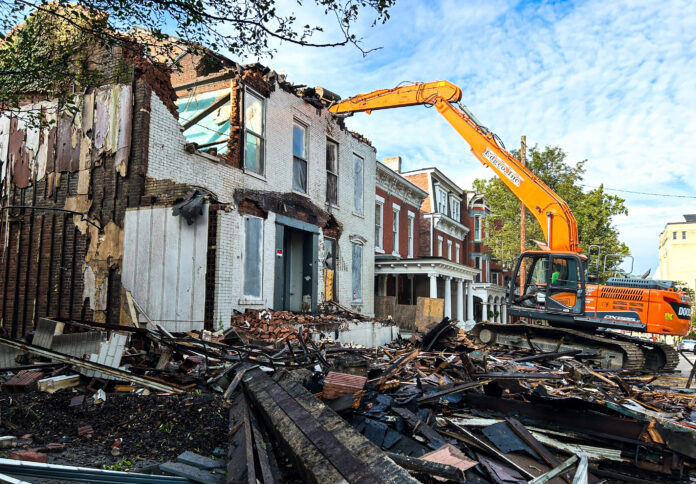
You can live across the world and own – and abandon – a piece of property in the middle of any neighborhood anywhere in West Virginia and let it rot to the ground before a city-financed demolition takes place to remove the public safety hazard, and your only penalty is that the state takes possession of the vacant lot that you were done with anyway.
While the structure on your lot deteriorates into dilapidation, you can borrow against its worth and no one can stop you. Sure, if the building is vacant, there’s a fine for that, and there’s also “raze or repair” orders a city can issue, but if you’re walking away from the parcel, there’s no cash penalty you’ll incur.
Sure, a tax lien is placed on the property, but guess what? A tax lien doesn’t appear on your credit report. Ever.
Meanwhile, the impact on nearby property values is alarming, and nearly every neighborhood in the Northern Panhandle has been affected by the gradual decline of an old house with an unkept lawn, crooked bushes, and a broken window or two. The gutters clog and decay – often ruining a house’s eaves – and then paint starts chipping, and once roof springs a leak, the dwelling is doomed and will soon disintegrate.
Brick by brick.
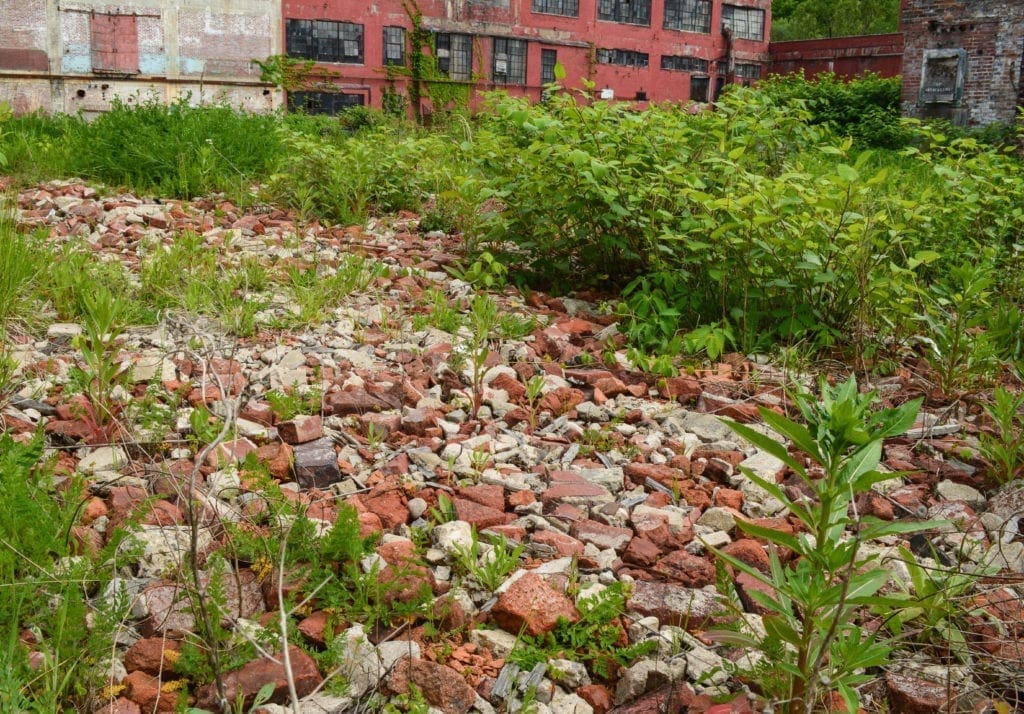
Some areas in the “Friendly City”, like Wheeling Island, Warwood, and South, East, and North Wheeling, have eroded the most, and the City of Wheeling has financed hundreds of demos on the taxpayers’ dime for several years. Once the land is cleared and the tax lien is placed on the parcel, the land doesn’t collect for the tax base until a new owner comes along to re-develop.
If, that is, a new owner ever comes along. There are more open lots on Wheeling Island today than anyone remembers, and the same can be said about the city’s other older neighborhoods.
House Bill 4977 would change that reality because it’s “A BILL to amend and reenact §8-12-16 of the Code of West Virginia, 1931, as amended, relating to authorizing municipalities to adopt an ordinance to recover demolition costs as special tax assessments.”
Simple. It’s legislation that would allow cities to go legal to get their money back while property owners come to realize that the days of holding a neighborhood hostage with a blighted parcel are over.
Of course, there is a high number of “gotta do this first” notice requirements within the legislation because, HEY!, property ownership is considered a very big deal by the vast majority of property owners. But some have been going about their business much differently for the past few decades because demand has declined as the population has diminished.
If Wheeling Council were to miraculously pass a funded ordinance to demolish all of the dilapidated buildings in the municipality today, it would involve more than 130 properties and cost a little less than $3.3 million.
That’s a lot of road paving, slip repairing, and bike lane painting the City could do instead.
Initially, this bill – if approved – will likely provoke attorneys to search and discover new legal loopholes, and that’s when state lawmakers will need to recognize those new paths and amend the law accordingly. Sadly, that’s what will be necessary to continue protecting the real estate investments made by current residents and by those moving into the Mountain State.
Eventually, this new law could ultimately alter the mindset surrounding residential and commercial property ownership in West Virginia, and it would protect the state’s responsible property owners against financial loss caused by irresponsible greed.
House Bill 4977 was communicated to the 34-member state Senate on “cross-over day,” and lead sponsor Del. Bill Flanigan from District 4 in Ohio County collected 10 co-sponsors from all regions of the Mountain State. Several state Senators know about the bill, and hopefully they will push it to approval so it can be signed into law by Gov. Patrick Morrisey.
I proposed the bill’s premise in early 2025 to House Majority Pat McGheehan (R-1), and I’ve been working with bill writers, lawmakers, and with Del. Flanigan ever since. That’s because House Bill 4977 could be the most important economic improvement legislation our 134 lawmakers consider this session, and that’s because it would give our cities the muscle necessary to fight these crimes one demo bill at a time.