

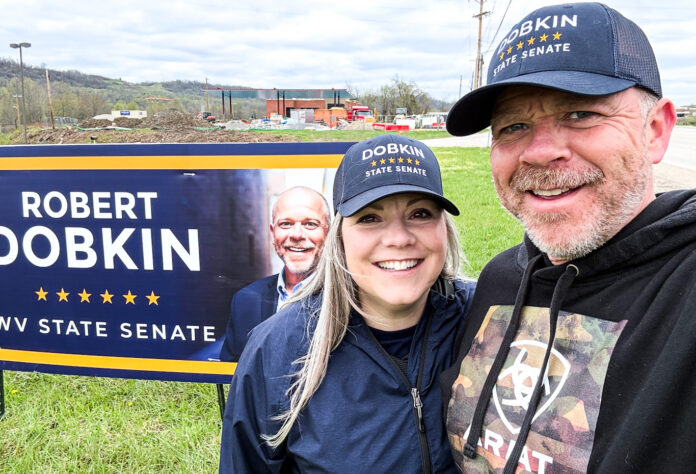

Robert Dobkin is a candidate in the Republican Primary for the 2nd District of the West Virginia Senate, and he’s listed his “Top Issues” as Restoring Civility, Economic Development, Rebuilding Infrastructure, Improving Schools, and Increasing Access to Affordable Healthcare.
Below, Dobkin answers specific questions concerning each of those issues.
RESTORING CIVILITY – How?
I intend to restore civility in public life by leading with respect, focusing on shared values instead of division, and treating people with dignity — even when we disagree. West Virginians are tired of anger, insults, and political theater. I believe we can stand firmly for our principles while still listening to one another, working together when possible, and remembering that we are neighbors first and political opponents second. Civility is not weakness — it is leadership grounded in character, accountability, and service to the people of West Virginia.
ECONOMIC DEVELOPMENT – What is government’s role when it comes to economic development?
I believe the private sector creates prosperity, but state government has a responsibility to create the foundation for economic success. That means better infrastructure, stronger workforce training, reliable energy, and a business climate that encourages investment and job creation here in West Virginia — without wasting taxpayer dollars or picking winners and losers. We should support our traditional industries while also preparing for the next generation of jobs and opportunities. That means:
Infrastructure Investment — roads, bridges, broadband, water systems, and reliable energy infrastructure are essential for attracting employers and supporting local communities.
Workforce Development & Education — preparing workers for skilled trades, manufacturing, healthcare, technology, and energy jobs through strong public schools, vocational training, apprenticeships, and higher education partnerships.
Business Climate & Regulatory Reform — maintaining reasonable taxes and predictable regulations so businesses can grow without unnecessary bureaucracy, while still protecting workers, property rights, and the environment.
Supporting Entrepreneurship & Small Business — helping local entrepreneurs access capital, technical assistance, and streamlined licensing so West Virginians can build businesses here at home.
Economic Diversification — strengthening traditional industries like coal and natural gas while also pursuing manufacturing, tourism, agriculture, aerospace, data infrastructure, and emerging technologies.
Regional & Rural Development — ensuring smaller towns and rural counties are not left behind by targeting investment where economic opportunities are limited.
Fiscal Responsibility — using incentives carefully and transparently so taxpayers see measurable returns rather than corporate giveaways.
REBUILDING INFRASTRUCTURE – If your campaign is successful, how would you fund a statewide rehabilitation project on West Virginia’s secondary roads?
West Virginia’s secondary roads are the lifeblood of our communities, yet too many have been neglected for decades. If elected, I would focus on fixing roads first by prioritizing existing transportation funding, creating a dedicated secondary roads rehabilitation fund, aggressively pursuing federal infrastructure dollars, and demanding greater transparency and accountability in how road money is spent. I also believe industries placing heavy strain on local infrastructure should help contribute to upgrades where appropriate.
Most importantly, we need to stop treating road maintenance like a short-term patching operation. West Virginians are tired of potholes, deteriorating bridges, and temporary fixes. We need a long-term rehabilitation strategy that is fiscally responsible, transparent, and focused on rebuilding the infrastructure our economy and communities depend on.
IMPROVING SCHOOLS – What are the three biggest issues with the state’s public school system, and what steps would you take – if elected – to address those problems?
Education is the foundation of Economic Development
West Virginia’s public schools face many challenges, but I believe the three biggest issues are:
- declining student achievement and workforce readiness,
- classroom discipline and teacher retention, and
- an outdated and inequitable funding structure.
1. Improving Student Achievement and Workforce Readiness
Too many students are falling behind in reading, math, and career preparedness. At the same time, many employers cannot find enough skilled workers. We need to reconnect education with opportunity.
If elected, I would support:
- stronger early literacy and math intervention programs,
- expanded career and technical education tied directly to local industries,
- workforce partnerships with community colleges, unions, and employers,
- greater classroom flexibility for teachers instead of excessive bureaucracy, and
- more emphasis on practical life skills, trades, technology, and civics education.
Every student should graduate prepared for college, the workforce, military service, or skilled trades — without leaving West Virginia to find opportunity.
2. Restoring Discipline, Safety, and Teacher Support
Teachers and students cannot succeed in chaotic classrooms. Across our state, educators are overwhelmed by discipline problems, staff shortages, burnout, and lack of support services.
I would push for:
- expanded school-based mental health resources,
- alternative learning placements for chronically disruptive students,
- stronger parental accountability and intervention requirements,
- policies that protect teachers and restore classroom authority, and
- competitive pay and retention incentives to keep qualified educators in West Virginia.
No teacher should feel unsafe at work, and no student should lose their chance to learn because disorder dominates the classroom.
3. Modernizing the School Funding Formula
West Virginia’s school aid formula no longer reflects today’s realities. Counties are struggling with rising special education costs, transportation expenses, and staffing shortages.
I would support:
- revisiting and modernizing the school aid formula,
- targeted funding based on actual student needs,
- additional support for special education and behavioral services,
- responsible fiscal oversight to ensure dollars reach classrooms, and
- reducing unfunded mandates on local school systems.
Counties should not be penalized for complying with federal requirements or serving high-needs students.
I believe West Virginia can have strong public schools again — but it will require accountability, discipline, local control, and real investment in students and teachers. Education is not just a budget item; it is the foundation for our economy, our communities, and our future.
INCREASING ACCESS TO AFFORDABLE HEALTHCARE – What do you believe West Virginia can do to ensure its citizens are eligible for healthcare that actually is affordable?
West Virginia can make healthcare more affordable by focusing on access, prevention, and workforce.
West Virginians do not just need to be “covered” on paper — they need healthcare they can actually afford, reach, and use. I would support protecting access to basic coverage, strengthening our rural hospitals and clinics, expanding telehealth, and investing in more doctors, nurses, mental health providers, and addiction-treatment professionals in underserved areas. Every rural county in West Virginia is designated as a healthcare shortage area, so affordability means little if there is no provider nearby.
We should also lower costs by emphasizing preventive care, chronic disease management, price transparency, prescription-drug affordability, and community-based care that keeps people out of expensive emergency rooms. West Virginia recently secured about $199 million in Rural Health Transformation funding, and I believe those dollars must be used wisely — not for bureaucracy, but for real improvements in local care, workforce recruitment, transportation, technology, and rural access.
At the same time, we need to protect taxpayers. That means auditing programs, cutting waste, supporting local providers, and making sure assistance goes to people who truly need it. My goal is simple: a healthcare system where working families, seniors, veterans, and rural communities can get care before a crisis — without going broke to do it.