

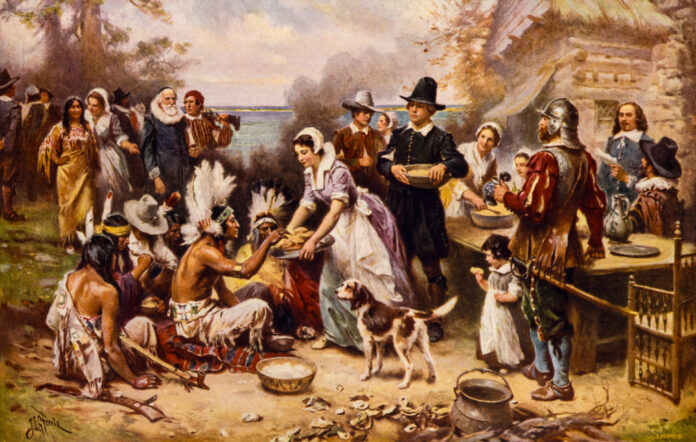

I’ve seen far too many drawings of the “first” Thanksgiving with the kind smiling natives breaking bread with settlers in 1621.
It’s important that the record be set straight.
The settlers were attempting an experiment in Socialism and communal farming. It failed in rather spectacular fashion, as Socialism always does, killing by starvation suffered by nearly half of the Mayflower passengers.
If that drawing was correct, it would be healthy and well-fed Native Americans feeding gaunt and starving settlers. Imagine that you are weakened settler and a huge contingent of Wampanoag warriors show up bearing gifts of food. You would be more than a little freaked out.
What they didn’t know was Wampanoag tribesmen were not only saving them but had an ulterior motive. The leader of the Wampanoag confederacy, Massasoit Sachem, had a plan. It included sending Squanto to live among the settlers.
Of course, neither the Chief nor the colonial leaders Myles Standish, William Bradford, Edward Winslow, or Stephen Hopkins, and others, knew that their very presence would result in an “unidentified disease” that would devastate the Native American population in the area. Understanding germ theory was more than a couple of hundred years in the future.
So, the settlers were starving. This was far from the first time that Socialism killed large groups of people, but it was very far from the last. It was then, and it is still a horrible way to die. Ask any Venezuelan or Cuban.
Communal farming does not work. It didn’t work 400 years ago, and it’s led to starvation ever since. If it weren’t for the Native Americans, things would have turned out very differently for the settlers. If it weren’t for capitalism today, and our leaders’ decision to sell wheat to our Cold War enemy, the Soviet Socialist Republics, would have met a similar fate.
While the settlers used their guns to go out “fowling” and bring back stringy wild turkey for the Thanksgiving feast, the Wampanoag arrived with venison and wild fruits and berries that were nutritionally dense. Those were edibles the settlers didn’t yet know about.
The three-day feast was a blend of cultures, adding to the resilience and resourcefulness of both groups. The Native Americans saved the settlers in their moment of need, and Squanto, who was embedded with the settlers, taught them a sustainable (and capitalist) way forward.
So why, you might ask, would the chief of the Wampanoag inconvenience his tribe to save these interlopers from Europe, the settlers? Massasoit Sachem was a savvy strategist and understood that the colonists with their guns would be a worthy ally in their skirmishes with the Narragansetts, a competing tribe.
The enemy of my enemy, after all, is my friend.
He wanted and received an alliance. It only worked if the settlers stopped their foolish collectivist ways and were not starving to death. Again, though, there was the ulterior motive, and it was successful for a while.
Later on, in a magnificent display of capitalism, the chief sold the settlers 14 square miles of land to support their growing colony.
That’s my take on the holiday we just celebrated.
While history will record what happened, it’s so critical to understand why it happened.