

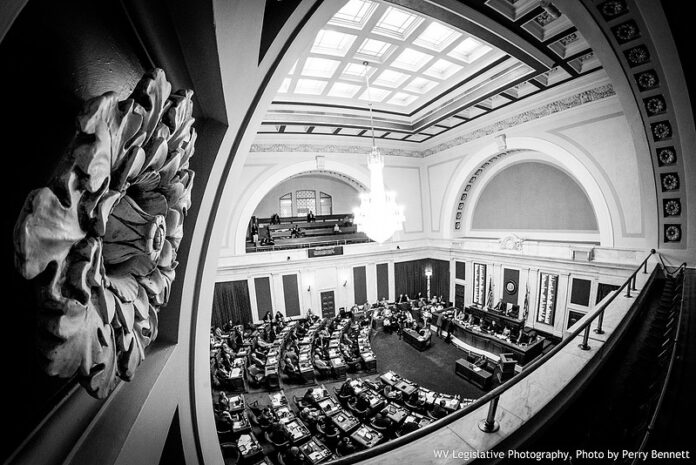

(Cover photo by Perry Bennett, W.Va. Legislative Photography)
In elementary school, we learned that “C” is for cat, “C” is for cookie, and “C” is for courage.
In the West Virginia Legislature, “C” is for compromise.
Compromise is not a flashy word. It does not rally a crowd or fit neatly on a campaign sign. It rarely trends on social media, but inside the marble walls and floors of the State Capitol, compromise is often the difference between a bill becoming law and one that quietly dies on the calendar.
Many people assume legislation passes because one party has the votes or because an idea is simply “right.” The truth is far more complicated. Even in a chamber with a supermajority, personalities differ. Districts differ. Priorities differ. What works in the Eastern Panhandle may not work in the Southern Coalfields. What makes sense for a small rural county may raise concerns in a growing community.
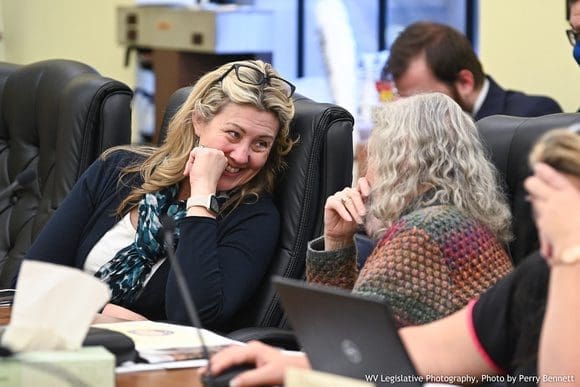
If you want to get a bill across the finish line, you must understand that every member represents a unique set of constituents and interests. That reality demands compromise, and not just from legislators.
Too often, we talk about compromise as something that only lawmakers must do. In reality, successful legislation requires three groups to bend at least a little. They are legislators, vested parties, and constituents.
Start with the lawmakers. Compromise does not mean abandoning your principles. It means recognizing that the perfect bill in your mind may not be the bill that can garner 51 votes in the House or 18 in the Senate. It means asking questions. What is essential? What is negotiable? What language clarifies rather than complicates? What amendment addresses a legitimate concern without gutting the bill’s intent?
In the committee process, compromise begins early. A bill is introduced. Stakeholders weigh in. Members propose amendments. Sometimes the changes are small. Simply tightening definitions, adjusting effective dates, or adding reporting requirements. Other times, the changes are more substantial, phasing in implementation, narrowing applicability, or adding guardrails to protect taxpayers.
Each change is a negotiation. Each negotiation recognizes that legislation does not exist in a vacuum.
That brings us to vested parties, the groups, organizations, industries, and advocacy coalitions that care deeply about the outcome. They are often labeled simply as “lobbyists,” but that term oversimplifies the role. Many represent employers, workers, hospitals, utilities, teachers, local governments, and nonprofit services. They bring expertise that legislators do not always have, and they identify unintended consequences that legislators may not anticipate.
But vested parties also must compromise.
An industry rarely gets all the protections it requests. An advocacy group rarely gets every mandate it wants. A local government rarely receives all the funding it seeks. When a stakeholder insists on an all-or-nothing approach, legislation frequently collapses under its own weight.
A bill designed to help can stall because competing interests refuse to meet in the middle.
The most effective stakeholders are those who walk into a meeting not just with a list of demands but with options. They ask, “What problem are we trying to solve?” instead of “How do I win?” They understand that partial progress is still progress.
Finally, there are the constituents, who play a larger role than they may realize.
Legislators do not operate in isolation. Phone calls, emails, town halls, and social media shape how members evaluate a bill. Public opinion matters, but it is important for legislators to realize that much of the noise often comes from the vocal minority. Compromise also becomes difficult when the expectation from home is absolute perfection.
Every bill affects people differently. A regulation that helps consumers may burden a small business. A tax policy that aids economic development may be concerning to taxpayers. A public safety proposal may raise civil liberties concerns. Reasonable people can disagree.

Constituents sometimes want legislators to fight to the bitter end and never give an inch. Yet governing requires weighing competing goods, not choosing between pure good and pure bad. If voters demand zero flexibility, they unintentionally encourage gridlock.
Compromise from constituents does not mean disengaging or staying silent. It means understanding that improvement is often incremental. It means recognizing that a 70- or 80-percent solution that passes is more impactful than a 100-percent solution that never leaves a committee agenda.
Compromise also requires listening. That sounds simple, but it is not. It means sitting down with a member who opposes your bill and asking why. It means hearing from an industry group that fears unintended consequences. It means acknowledging a valid concern raised by an advocacy organization. It means understanding that what appears to be an obstruction may, in fact, be caution born of experience.
Some of the most productive conversations happen off the floor, over coffee in someone’s office, in a quiet corner of the chamber, or during a quick walk between meetings. Trust is built in those moments. When members trust one another, compromise becomes possible.
Without trust, compromise feels like surrender. With trust, it feels like collaboration.
There is also a strategic component. Legislative calendars are unforgiving. Crossover Day looms, and committee action deadlines approach quickly. A bill that lingers too long can miss its window. Knowing when to hold firm and when to accept a reasonable amendment is part art, part experience.
Sometimes a bill sponsor must decide if it is better to pass 80 percent of what I want this year and build on it next session, or risk getting nothing at all. Incremental progress is often how durable policy is made.

West Virginia has seen this time and again. Major reforms, whether in education, economic development, infrastructure, or pretty much any other topic, rarely pass in their final form on the first attempt. They evolve. They are shaped by debate. They are improved by critique. They are tempered by compromise from lawmakers, stakeholders, and the public alike.
Critics of compromise argue that it waters down strong ideas. At times, that criticism has merit. There is a line between healthy compromise and surrendering core values. Legislators must know where that line is for them. But refusing to engage in compromise at all can lead to gridlock. A bill that never moves helps no one.
It is worth remembering that compromise is embedded in the very structure of our system. A bill must pass both chambers. Differences between the House and Senate versions must be reconciled. Conference committees, by definition, are exercises in compromise. Even after passage, the Governor may request changes or issue a veto that prompts further negotiation.
The process is designed to slow things down, to force deliberation, and to require consensus-building. That can be frustrating. It can also be wise.

For constituents watching from home, compromise can look messy. It can appear as backroom dealing or political horse-trading. Communication matters. Legislators owe it to their constituents to explain why changes were made, what concerns were addressed, and why the final product still advances the public interest.
When done well, compromise strengthens legislation. It exposes weaknesses before they become problems. It broadens support. It increases the likelihood that a law will withstand legal challenges and stand the test of time.
As the session progresses and bills inch closer to the finish line, remember that success is rarely about a single speech or a party-line vote. More often, it is about conversations, concessions, and careful calibration.
“C” is for compromise. It is not glamorous. It is not easy. It requires patience, humility, and persistence from lawmakers, stakeholders, and the people they represent. It is equally important when considering candidates. They may be the ones to affect your life in the next session. Choose wisely.
In a place where every vote counts and every district matters, compromise is how you get to “yes.”