
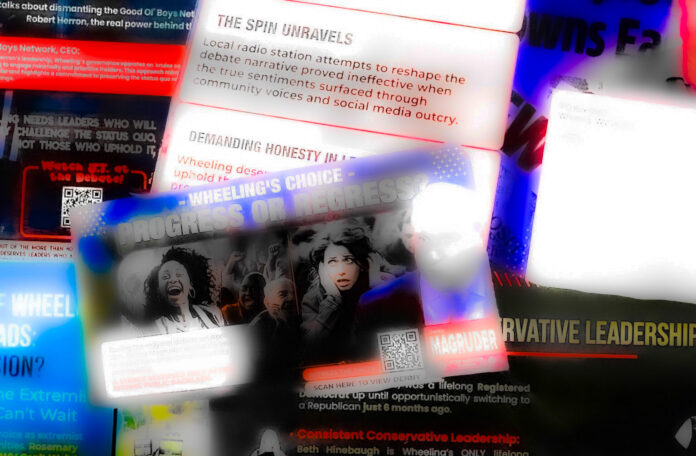

In West Virginia, you don’t have to look far to find campaign mailers. They arrive in stacks, day after day, and week after week, especially as Election Day draws near. The question voters often ask, do these things actually work?
The answer can be “Yes”, and it can be “No”.
Political mailers absolutely play a role in elections, particularly in a state like West Virginia where local races still matter and personal contact carries weight. Relationships matter. Making the effectiveness of mailers far more limited, and far more complicated, than many campaigns would like voters to believe.
Let’s start with what the research indicates.
Direct mail remains a staple of modern campaigns because it is one of the few ways to physically place a message inside a voter’s home. Unlike digital ads that can be skipped or ignored, mailers get handled, seen multiple times, and often discussed among family members. That alone gives them a certain level of influence, especially among older voters who are more likely to read and trust printed material.
There is evidence that mailers can move the needle in specific ways. Studies show they can increase name recognition and even boost a voter’s intention to turn out. In lower-profile races, like many legislative or local races in West Virginia, this matters. If voters don’t know the candidates, the candidate they recognize often has an advantage.
When it comes to actually changing minds or dramatically increasing turnout, the effects of political mailers are surprisingly small. Large-scale field experiments have found that campaign mail has little impact on voter turnout, and in some cases, especially when the messaging is negative, it can even reduce participation.
All those glossy, expensive, often harsh mail pieces flooding your mailbox? On average, they don’t dramatically change how people vote and may even turn some voters off entirely.
That lines up with a broader truth in political science, most campaign messaging, whether it’s mail, television, or digital ads, tend to have only modest effects on voter behavior. People’s political views are shaped over time by values, experiences, and trusted relationships, not just by a last-minute mailer.
Hopefully, one cannot be a jerk up until the time they decide to run and be elected.
Back to mailers.
Timing matters, too. Research shows that mailers sent earlier in a campaign can help shape perceptions, but those arriving in the final days, when West Virginia mailboxes are most flooded, often have diminishing impact because voters have already formed opinions.
So why do campaigns and outside groups keep spending so much money on them? Because even small effects can matter in close elections. A few percentage points here. A slight increase in name recognition there. A nudge to reinforce what a voter already believes. In tight races, that can be the difference between winning and losing.
Mailers are particularly effective at one thing, and that is reinforcement. They don’t usually change minds, but they can strengthen existing opinions. If a voter already leans toward a candidate, a steady stream of mail can validate that choice. If a voter already dislikes a candidate, negative mail can deepen that feeling.
That’s why so many of the mailers you see are not informational. They are emotional.
Which brings us to an important point for West Virginia voters. If you feel overwhelmed by the negativity, you’re not alone, and you’re not imagining it. Political mail often pushes right up to the edge of what’s factual, because the legal bar for proving defamation in campaign materials is extremely high. That gives campaigns and outside groups wide latitude to frame issues in ways that are technically defensible but potentially misleading.
Here’s the catch, even when voters say they don’t like negative campaigning, it still grabs attention. It sticks. It sparks conversation. That’s part of why it persists, but attention is not the same as persuasion.
In fact, in many cases, the flood of negative mail may have the opposite effect. Many complain of election fatigue, skepticism, and even disengagement. Voters begin to tune it out, treating each new piece as just more noise.
That’s especially true in smaller communities across West Virginia, where personal relationships, local reputation, and word-of-mouth still carry enormous weight. A mailer might introduce a name, but it’s often a conversation at church, a community event, or a trusted neighbor’s opinion that ultimately shapes a vote.
Mailers are part of the equation, but they are not the deciding factor most of the time.
They are tools. Sometimes effective. Often overused. Occasionally misleading. Rarely decisive on their own.
For voters, the takeaway is simple but important. That message is don’t give them more power than they deserve.
Read them if you want. Glance at them if you must. But don’t rely solely on any of them. Fact check on your own, starting with who is sending them.
Because the reality is, the most effective voters in West Virginia are not the ones with the fullest mailboxes, they are the ones who look beyond them and do their own research.
They ask questions. They seek out multiple sources. They rely on judgment, not just messaging.
At a time when campaigns are investing heavily in trying to reach you at your mailbox, the most powerful thing you can do is remember this: Just because it showed up in your home doesn’t mean it should decide your vote.